
Vacuum technology is the science of the removal of all (or nearly all) gases from a chamber, and the measurement and manipulation of the vacuum environment. The applications of vacuum technology are as broad as modern technology itself, ranging from holding work-pieces (vacuum chucks) to Thermos flasks, energy saving glass, CDs and DVDs, incandescent light bulbs and cathode ray tubes, medical scanners and chemical analysis tools, to high energy physics research facilities and the development of the next generation of nuclear power (nuclear fusion).
The requirements of these technologies on the vacuum environment are equally broad, demanding the application of a wide range of techniques to achieve them. The absolute pressure, partial pressures of particular residual species and electronic, magnetic and physical effects of the pumps on system processes all need careful attention when designing a system.
With pressure requirements for different processes ranging from a few tenths of an atmosphere (vacuum chucks etc.) to less than a trillionth of an atmosphere (eg. surface science applications), and with vastly different sets of physical laws applying, vacuum science is necessarily sub-catagorised into a number of vacuum regimes. The pressures of transition from one regime to another are open to some interpretation and can depend on system configuration, but the chart (below) is a guide to what vacuum engineers mean when they talk about rough, process, high and ultra-high vacuum:

Oxford Vacuum Science Ltd
18 Enstone Road
Middle Barton
Oxfordshire
OX7 7BN UK
tel: +44 (0) 7495 463875
OVS@oxford-vacuum.com
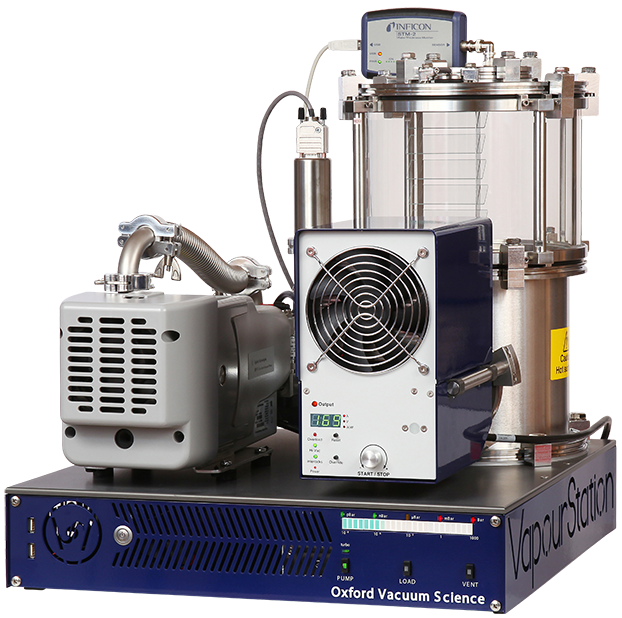 bench-top high vacuum