
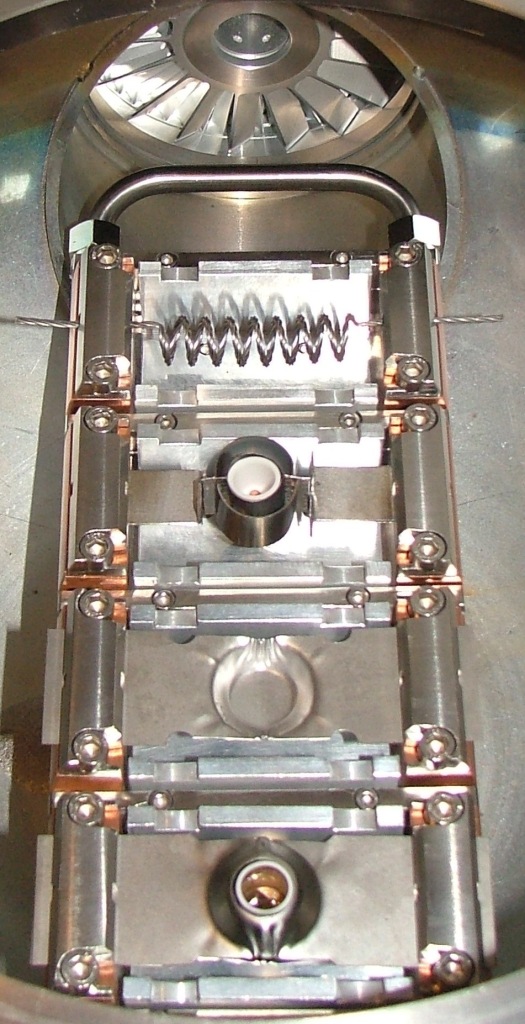
 high performance
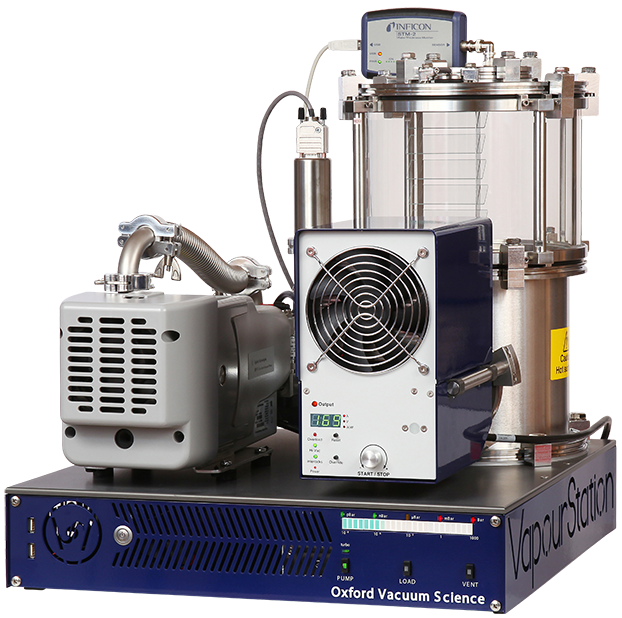 bench-top thermal evaporators from
When a pan of water is left to boil on the stove, droplets of water form on the ceiling of the kitchen. If the boiling water is then transfered to a bowl and quickly placed in the freezer, a layer of ice forms above the bowl. Given a high enough temperature, the same cycle of evaporation and condensation can be used to form films of virtually any material that remains stable in a vapour state. When used to apply very thin films in a high vacuum environment, this process is known as 'thermal evaporation'. The heat is provided either by Joule heating via a refractory metal element (resistive evaporation), or directly from a focussed beam of high energy electrons (electron beam evaporation). Other deposition techniques, such as laser ablation or a cathodic arc deposition, use essentially the same effect using a high power laser or an electric arc, but are rarely referred to as thermal evaporation. Indeed thermal evaporation is often taken to be synonymous just with resistive evaporation.
|
When a high current is passed through a resistive element such as a light bulb, the filament gets white hot.
Use a heavier filament and hook a few pieces of metal wire (such as gold or aluminium) and the metal
wire will first melt and flow along the filament, like solder on a soldering iron (known as
'wetting'), and then evaporate. This is the crudest but probably most common form of resistive
evaporation, known as filament evaporation. Evaporation filaments typically draw 50-100A at 6-20V. Only
small amounts of material can be evaporated in any individual evaporation and filaments are awkard to load,
restricting its use to the lab. |
 |
|
The element need not be a helical filament though - a thin sheet of Tungsten or Tantalum with a dimple or
depression holds more material and is easier to load. However, whilst voltages are lower, currents can be as
high as 300-400A, requiring high performance equipment, such as Oxford Vacuum Science's
VapourPhase Ω. Variations on
boat sources, such as long 'slot' sources, are used in large scale industrial coating plant in
applications such as architectural glass coating. |
 |
|
Some materials, such as Silicon Monoxide, have a tendancy to 'spit' fragments of solid material which
can damage the substrate and ruin film quality. This spitting can be contained within a closed cell, the whole
of which forms the heating element. Because the whole cell is hot, the evaporant gases can follow an indirect
route to an exit aperture without condensing, with no direct line of sight between source material and
substrate. 'Baffle boxes' also have the advantage that they can be designed to deposit horizontally or
even down, whilst boat sources can only coat a substrate vertically above them. |
 |
| Where there is a risk of the evaporant reacting with the element it can be heated indirectly in a ceramic crucible. Crucible heaters come in a wide variety of forms, from simple wire baskets to baffled tungsten blankets. Like an incandescent light bulb, a great deal of power is lost through radiated heat, particularly with larger surface area heaters. Baffled crucible heaters greatly reduce these losses and allow for high temperatures to be achieved at reduced currents. Indeed crucible evaporation can offer efficient, controlable evaporation for a wide range of materials and applications. |  |
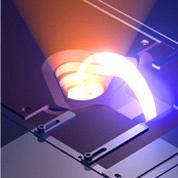 image courtesy of Temescal Inc.
 |
A much 'higher tech' approach to thermal evaporation is to heat the evaporant directly using a focussed beam of high energy electrons. The evaporant sits in a heavy, water-cooled copper hearth and a beam of electrons is emitted from a filament, usually set below the hearth, is accelerated through an extraction grid and bent through 270° before striking the melt. Heating can be very localised and is not limited by the melting point of a heater element, so even the highest temperature materials such as refractory metals can be eb evaporated. eb evaporation is a powerful and controllable technology but requires complex and costly drive electronics and is not as easily linearly scalable as resistive evporation - popular in process applications, such as opthalmic coatings, but often an unnecessary expense in the lab. |
Evaporation data and common deposition methods for various elements are listed at the thermal evaporation reference periodic table link. Oxford Vacuum Science manufactures high performance resistive evaporation power supplies and source mounting systems and bench-top thermal evaporation systems for research and development and light industrial applications. For more details contact technology@oxford-vacuum.com or click on the contact link.
Oxford Vacuum Science Ltd
18 Enstone Road
Middle Barton
Oxfordshire
OX7 7BN UK
tel: +44 (0) 7495 463875
OVS@oxford-vacuum.com